
Recurring Health Checks
Only Team Administrators have the ability to set the recurrence of a meeting.
Recurring health checks help teams consistently track sentiment and team health over time by automatically generating a new health check based on your chosen frequency. This ensures that check-ins happen regularly without the need to manually create each one. Team members can respond at any time allowing to run health checks asynchronously.
Invitations and invite codes will remain valid for future health checks. Permalinks will always point to the most recent health check.
How recurring health checks work
- The first health check opens as soon as you start the series. By default, each later one opens once the previous one has closed, but not before the previous one's date.
- Participants can add their responses ahead of time once a session is available.
- Each health check's invite goes out by the channels chosen under INVITE. INVITE TEAM IMMEDIATELY sends the first one straight away.
Creating a new recurring health check
-
Go to the TEAMS tab and select the appropriate team.

-
Go to HEALTH CHECKS and select START HEALTH CHECK.

-
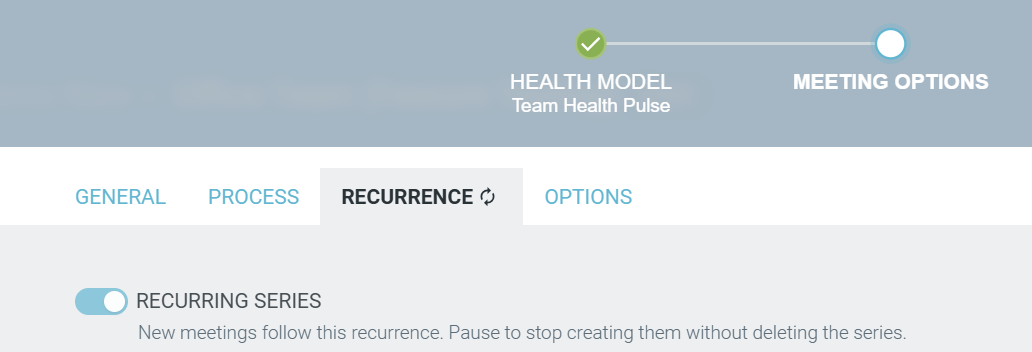
Once you have selected your template, go to the RECURRENCE tab and enable RECURRING SERIES. The DATE on the GENERAL tab then shows the first health check's date, which the recurrence sets.
The recurrence can only be set when you initially create the meeting, on the Recurrence tab of the start dialog.
- Select the frequency of your health checks (e.g. every two weeks) and the day of the week it recurs on. You can also:
- INVITE the team by email, Slack or Microsoft Teams each time a health check opens
- Turn on REMINDERS to nudge participants who have not responded yet
-
CLOSE the health check on a specific date and time to allow a summary to be sent to the team
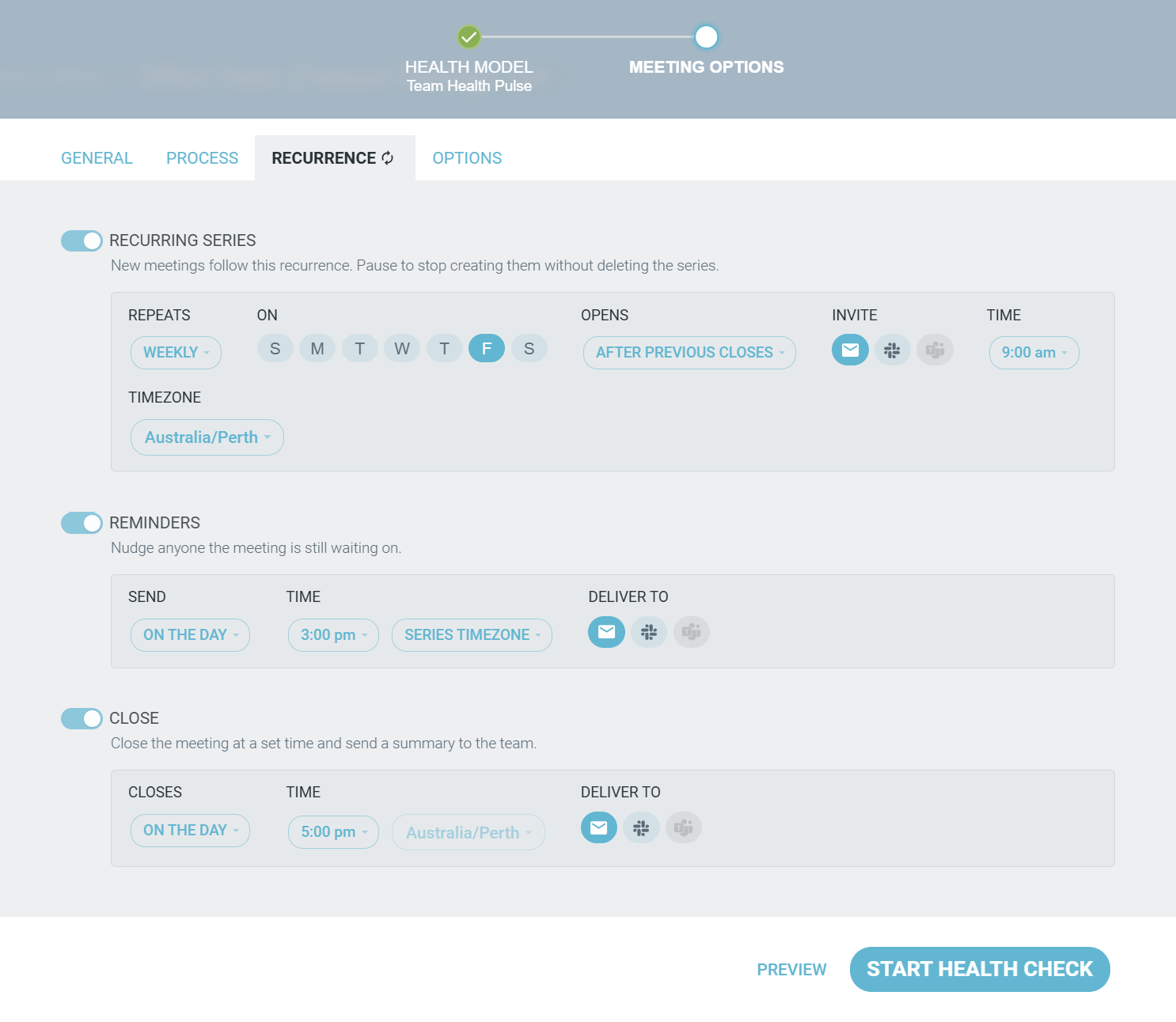
- When you have finished customizing, click on START HEALTH CHECK.


Naming a recurring series
The title you give a recurring series is the name of its next health check. If you leave it blank, the series is called "Health Check".
Numbered titles count up. If the title ends in a number, the series counts on by one each time a health check opens. For example, when "Sprint 21" opens, the next one will be "Sprint 22". A title with no number at the end, or one that ends in a year such as "Team check 2026", stays the same each time.
Renaming. Open the health check's options menu and select CUSTOMIZE HEALTH CHECK....
-
In an open health check, the title field is this health check's own title. Under Apply changes to, choose This health check only to rename just this one, or This and future health checks to rename this one and number the following ones on from it.
-
From the team page, or in a closed health check, the title field is the series title: the name the next health check will get.
Only Team Administrators can change the series. A facilitator who is not a Team Administrator can rename only the current health check.
Renaming the series does not rename health checks that have already opened.
Dates in titles. Reports, downloads, exports and Slack or Microsoft Teams posts add the date after the title, for example "Sprint 21 • 12 Nov 2026", so you can tell each health check in the series apart.
Canceling your recurring Health Checks
-
Go to your Team's HEALTH CHECKS page.

- Locate the recurring health check, click the OPTIONS icon (3 dots) and select CUSTOMIZE HEALTH CHECK.... On the RECURRENCE tab, switch off RECURRING SERIES and click SAVE CHANGES.


This will stop future sessions from being created but will not delete any existing health check data.