
Estimation decks
TeamRetro comes with eight pre-set planning poker decks, so you can estimate in a way that fits how your team works. Each deck gives you a different scale for talking about relative effort, complexity, and uncertainty. From quick “bucket” sizing through to more detailed number-based options.
There isn’t a single “best” deck. The right one is the deck that helps your team align quickly and estimate consistently for the kind of planning you’re doing:
- Early discovery / roadmap / triage: Keep it lightweight and avoid false precision.
- Sprint planning & delivery: Use a numeric deck so you can track velocity over time.
- High uncertainty: Pick a deck with bigger jumps as work gets larger.
- Repeatable work: Choose a deck with finer steps for easier comparison.
Want a deeper walkthrough? See our guide.
NOTE: You can also create custom estimation decks for more specific use cases.
Deck Types:
Scrum

(0, ½, 1, 2, 3, 5, 8, 13, 20, ?, ☕)
A Planning Poker-friendly story point scale with small sizing (½), an explicit “very large” bucket (20), plus unknown (?) and break (☕).
- Good for: Most Scrum teams estimating for sprint planning and tracking velocity.
Fibonacci

(0, 1, 2, 3, 5, 8, 13, 21, 34, ?, ☕)
Non-linear jumps that get less precise as items grow. Useful when uncertainty increases with size.
- Good for: Product/feature work where larger stories need clearer separation and discussion.
Sequential

(1, 2, 3, 4, 5, 6, 7, 8, 9, ?, ☕)
Linear steps with even gaps for more fine-grained sizing.
- Good for: Well-understood, repeatable work (maintenance, small enhancements), especially if your team prefers consistent increments.
Half-Card

(1, 1½, 2, 2½, 3, 3½, 4, 4½, 5, 5½, ?, ☕)
Adds “in-between” options for tighter precision in a small range.
- Good for: Teams estimating mostly small-to-medium items who want more granularity without switching to time-based estimates.
Power of 2

(1, 2, 4, 8, 16, 32, 64, 128, 256, ?, ☕)
Exponential growth that strongly signals uncertainty as size increases.
- Good for: Early-stage initiatives, platform/infrastructure, spikes/R&D, or work with wide variance.
T-shirt size

(XS, S, M, L, XL, XXL, XXXL, ?, ☕)
Non-numeric buckets that are easy to discuss and align on, without over-optimising the number.
- Good for: Discovery, roadmap sizing, cross-functional workshops, or stakeholder-friendly estimation; often as a first pass before converting to points for delivery.
Modified Fibonacci

(1, 2, 3, 5, 8, 13, 20, 40, 100, ?, ☕)
A variation on the classic Fibonacci that reflects growing uncertainty as work gets larger, while giving extra separation for bigger, riskier items.
- Good for: Sprint planning, backlog refinement, product delivery teams, or mixed-complexity work where larger items need clearer differentiation.
Five Fingers
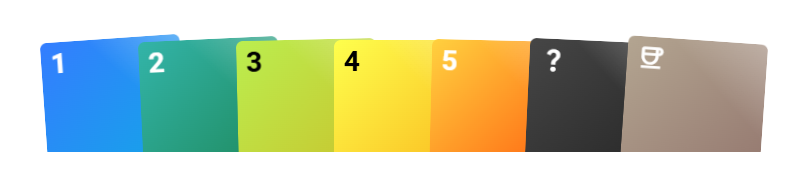
(1, 2, 3, 4, 5, ?, ☕)
A simple, low-range scale that keeps estimation fast and discussion-focused, with just enough spread to show relative effort.
- Good for: Smaller backlogs, newer agile teams, or workshops where speed and simplicity matter more than fine-grained precision.
Quick tip: match the deck to the planning stage
A common approach is:
- T-shirt sizing for early backlog refinement / roadmap conversations
- Scrum or Fibonacci for sprint planning & delivery (to keep velocity tracking consistent)